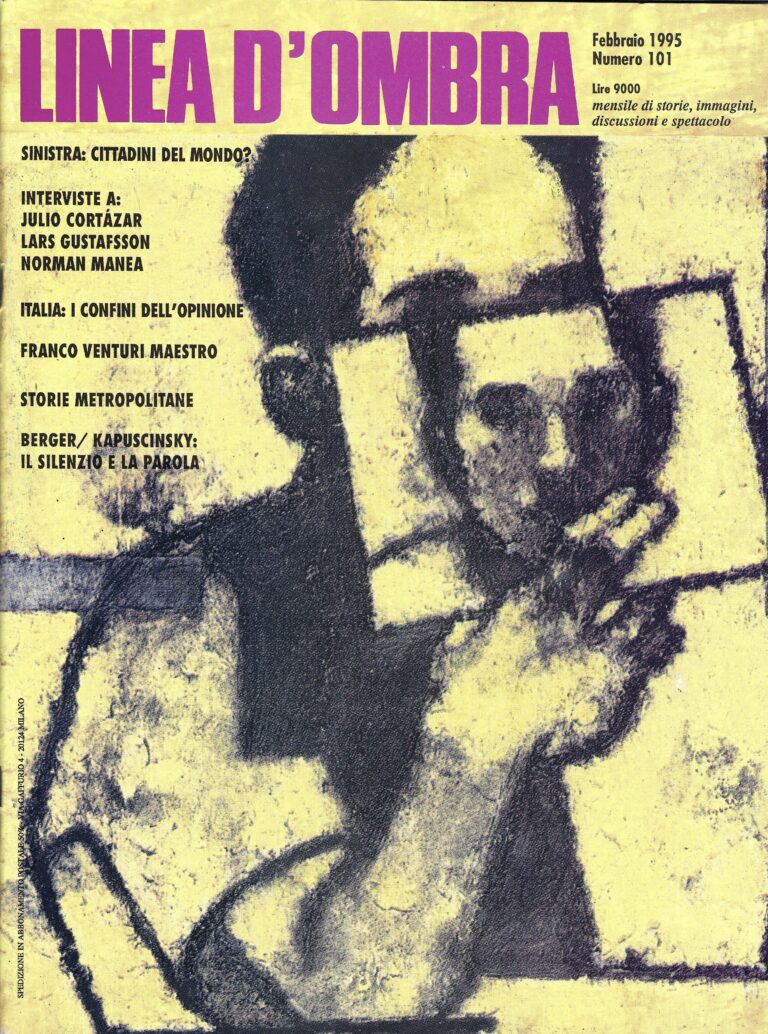
Shadow Line, February 1995, Number 1
A Chinese American Woman Had a Dream
edited by Scilla Finetti
A poet, radical feminist, and political activist, Nellie Wong—through her own family history—exemplifies one of the many experiences of the Chinese diaspora in America. Her father, who left for America at a very young age, returned to China several times to marry and father two children. To join him in America, his wife posed as his sister; consequently, when she became pregnant with Nellie, she was forced to find a fellow countryman—a man named Wong—who agreed to a sham marriage, thereby providing his surname to the child she was carrying, as well as to her other two daughters.
Growing up in Oakland’s Chinatown, Nellie endured the rigorous routine common to many young Chinese-American women: American school in the morning, Chinese school in the afternoon, and work at the family-run restaurant. Later, she found employment, and at the age of thirty-two, she enrolled in courses on literature, creative writing, and feminist theory at San Francisco State University. These studies provided the impetus for her to write and, in 1977, publish her first poetry collection, Dreams in Harrison Railroad Park; they also placed her in an environment that helped awaken her political consciousness.
Nellie went on to become an activist with the Freedom Socialist Party, featured prominently in the documentary Mitsuye and Nellie: Asian American Poets, and co-founded the Women Writers Union with other American writers. In 1983, she traveled to Beijing with this group to meet with the Chinese Women Writers’ Association and visit her ancestral family. Finally, in 1986, she published her second poetry collection, The Death of Long Steam Lady.
At the heart of her poetic analysis—which precisely identifies the point where individuality clashes and vibrates upon contact with environmental constraints—lies that particular form of female oppression we have come to recognize through the eloquent pages of Maxine Hong Kingston’s The Woman Warrior. It is an inquiry pursued with intrepid clarity, devoid of any trace of victimhood, and one that looks beyond the narrow confines of the “self” to reach wherever a human being suffers or faces discrimination.
This trajectory is evident in the evolution between her two poetry collections: while the first, Dreams in Harrison Railroad Park, is imbued with the fervor of self-discovery—expressed with a remarkable freshness of imagery and tone (the poem “How a Girl Got her Chinese Name” is particularly emblematic in its vivid, striking quality)—the second, Dreams in Harrison Railroad Park sees Wong’s poetic exploration deepen. It ventures into reflections on the human condition within the cosmos (“Territorial Visions”) and takes on a more pronounced sense of social consciousness (“My Chinese Love”).
Yet, it is especially in Dreams in Harrison Railroad Park that the themes of Wong’s poetics find their most complete expression. In this work, her capacity to transform herself into a mirror for the suffering of others—fueled by the momentum of a transformative dream—succeeds in unifying the fragmented, modest desires of the suffering humanity that populates this Oakland park, itself an emblem of so many other urban peripheries. It is a dream of “embroidering a new skin”—a vision capable of evoking other great dreams from American history and giving voice to its highest hopes.
Scilla Finetti is an Italian translator, scholar, and author specialized in English and Chinese literature, known for her pioneering work introducing Chinese American literature to Italian audiences.