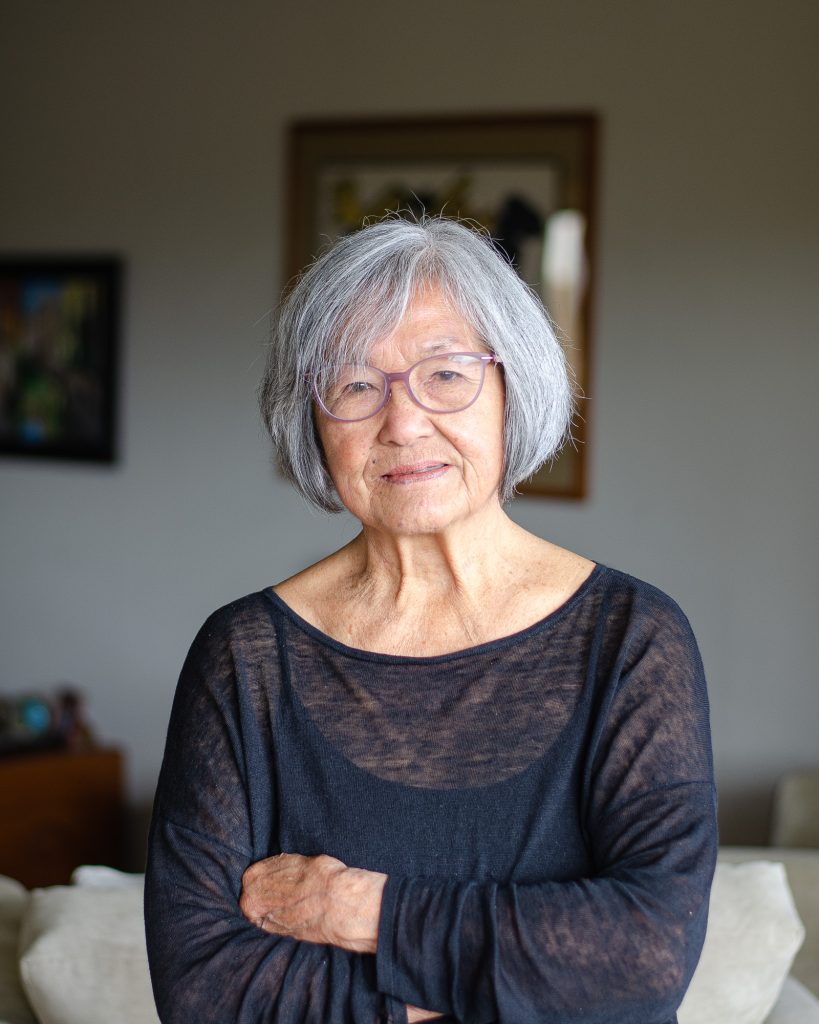
Nellie Wong, an acclaimed poet, feminist, socialist, labor activist and organizer, died on Friday, January 2, 2026, in her San Francisco home from ovarian cancer. She was 91 years old.
Nellie was born on September 12, 1934, in Oakland, California, in Chinatown. She was part of a family of nine – five immigrants, four American-born – that operated the Great China Restaurant from 1943 to 1961.
Nellie attended Oakland High School when her family moved to a neighborhood outside of Chinatown after World War II, the beginnings of integration for ethnic Chinese residents living under the Chinese Exclusion Act (1882-1943).
Her early life into her late twenties was rooted in the patriarchal culture in Chinatown and the white American mainstream. That oppression wasn’t sustaining. Nellie’s intelligence, creativity and compassion yearned to break free.
At Oakland High, she worked parttime as a secretary in the principal’s office, earning praise for her clerical and administrative organizational skills, a precursor to a future as a working-class advocate and organizer.
From 1964 to 1982, she worked at the San Francisco office of Bethlehem Steel Corp., in an administrative capacity. Her working-class life continued at the University of California San Francisco in various administrative assistant and analyst positions in the affirmative action office from 1984 to 1998.
In her mid-thirties, Nellie married James Balch, who along with sister Flo Oy Wong, urged Nellie to begin writing, given her enthusiastic oral reviews of movies and TV shows and pithy, humorous family newsletters. (She later divorced Balch.)
The world around her was changing to become more inclusive – the 1960s civil-rights movement that spawned the feminist movement and the empowerment of various non-white racial communities, including her Chinese cohort.
In the 1970s, when she was in her late twenties and early thirties, she enrolled at Oakland Adult Evening School and San Francisco State University, taking classes in ethnic and feminist studies and creative writing. Classmates influenced and encouraged her to write.
That is when she discovered an affinity for a burgeoning poetic voice to express her working-class Chinese American immigrant background. She also joined the Freedom Socialist Party and its affiliated Radical Women organization around this time.
Her growing political and creative journey included teaching poetry writing at Mills College, Oakland, and women’s studies at the University of Minnesota. It also led to five published books of poetry: Dreams in Harrison Railroad Park (1977), The Death of Long Steam Lady (1984), Stolen Moments (1997), Breakfast Lunch Dinner (2012), and Nothing Like Freedom (2024 on her 90th birthday).
At times soft-spoken but always friendly and often breaking into a warm smile, Nellie openly thirsted to feed her political, artistic and cultural interests. She read voraciously and widely, poetry from around the world, often re-reading works and re-watching movies and TV dramas, especially Korean and Chinese. She also devoured international films at specialized theaters. At many public protests advocating for social justice, however, Nellie’s voice was anything but soft.
She co-founded and led feminist artistic groups such as Unbound Feet with Nancy Hom, Genny Lim, Canyon Sam, Kitty Tsui, and Merle Woo, and the Last Hoisan Poets with Genny Lim and her younger sister, Flo Oy Wong.
She and a distinguished Japanese American writer Mitsuye Yamada were featured in Mitsuye & Nellie: Asian American Poets, a 1980 documentary by San Francisco filmmakers Irving Saraf and Allie Light.
Her political activism and prolific writing took her far and wide in the United States and overseas to Australia, Cuba, and even to the homeland of her parents and three older sisters. Her 1983 China trip with prominent feminist writers such as Tillie Olsen and Alice Walker didn’t have her ancestral village area on the itinerary. Through persistence, Nellie made that personal side trip, connecting with distant clan cousins.
Nellie won many honors and recognition, among them having excerpts of poems inscribed at two different sites of the San Francisco Municipal Railway system, a building in her name at Oakland High, and a 2022 Reginald Lockett Lifetime Achievement Award from PEN Oakland.
Her last book, Nothing Like Freedom, was published in 2024 to honor her 90th birthday by HoongHoongLookLook Press, a venture she and her friend, artist and educator Andrea (Andi) Wong, established outside of the traditional publishing world. Nellie wrote up until the last days of her life, working on a forthcoming book, December Sonata, composed of poems she wrote after learning of her terminal illness. December Sonata will be published soon.
In a 2002 essay, Revolutionary Love (Expose), published in HEArt, a publication of Human Equity Through Art, Nellie summarized cogently her life’s political and writing mission:
“Deep in my heart and through my life experiences, there is no better way to live than to fight for a better world. That sounds trite, but it isn’t. I love the idea of making change for the disenchanted, the dispossessed, not in a ‘do good’ manner for the sake of being altruistic, but for the possibilities that we humans with our spirit and fortitude can fight for. Writing poems details those challenges.”
Nellie is survived by sister Flo Oy Wong, brother William Gee Wong, brother-in-law Edward K. Wong, and three generations of nieces and nephews totaling 39.
A celebration of life memorial will be held on Saturday, February 14, 2026, from 1-4 p.m, at the Oakland Asian Cultural Center, Pacific Renaissance Plaza, 388 9th Street, Suite 290, Oakland CA 94607, which is two blocks from where she was born.
In lieu of flowers and other objects, please contribute in Nellie’s honor to the Freedom Socialist Party San Francisco, socialism.com/san-francisco.
(Obituary written by William Gee Wong; photo: Marcelo Potosi)